Our Cases
No magic - just our painstaking joint work on the site




No magic - just our painstaking joint work on the site

Sharing the most useful advices about marketing!
No magic - just our painstaking joint work on the site

Online search has changed dramatically. To find answers, choose products and services or compare options, users are turning to AI more and more often instead of Google. Instead of a familiar list of links, ChatGPT and similar tools give a ready recommendation with links to sources. This has significantly changed the approach to SEO.
In this article, we explain how ChatGPT search works, what affects a website's visibility in AI answers, and how to promote your website with ChatGPT. We share our hands-on experience with AI optimization and show how to track traffic from ChatGPT.
ChatGPT Search is a built-in web search feature in ChatGPT. It finds up-to-date information online and builds an answer based on it, with links to sources. OpenAI introduced the new AI search tool on October 31, 2024.
ChatGPT Search was preceded by SearchGPT, a prototype that ran separately from the AI assistant and was available for testing to a small group of users. Its best features were later integrated into ChatGPT Search, which is now available to a wide audience.
A classic chatbot without search answers based on what the large language model (LLM) learned during training. With ChatGPT Search, answers are built on a live web search. Unlike Google, AI search does not show the user a familiar list of relevant links. Instead, it analyzes the information it finds and delivers a ready explanation.
The growth of AI systems has changed how users search. Part of the sales funnel now happens directly in the chat. Users can describe their need, clarify product or service details, compare several options and get recommendations. If ChatGPT cites a website or mentions a company, the user can go straight to reviewing the offer or placing an order. ChatGPT Search does not replace classic SEO, but it makes your brand visible to more potential customers.
On the other hand, the mass adoption of AI assistants forces businesses to factor "zero-click" searches into their promotion strategy. This is when a person gets a complete answer to an informational query right in the conversation, without visiting the website. That is why promotion performance is measured less by traffic and more by the number of brand mentions and citations, and by their impact on leads and sales.
In classic SEO, websites compete for a place in search results. The goal of SEO optimization for ChatGPT is to increase the likelihood that the AI assistant will cite your website or mention your brand in its answer. To avoid confusion, let's go over the key terms related to AI search.
GEO (Generative Engine Optimization) is website optimization for answers in generative systems such as ChatGPT, Perplexity, Gemini and others. ChatGPT SEO is part of GEO.
AEO (Answer Engine Optimization) is optimization for systems that give direct answers to user questions. Results appear in text and voice search, as well as in snippets.
LLMO (Large Language Model Optimization) is content optimization for large language models. Page content is adapted and structured so that LLMs can understand the context and form an accurate answer.
| Criterion | Classic SEO | ChatGPT SEO |
| Main goal | Page visibility in search results and organic traffic growth | Presence in ChatGPT answers |
| Where the user sees the result | In the list of search results (SERP) | In the AI assistant's ready answer |
| Key optimization factors | Keywords, meta tags, technical SEO and internal linking | Context, content expertise, structure and source authority |
| Main performance metrics | Rankings, organic traffic, conversions | Brand citations and mentions in AI answers, visibility for target queries, referral traffic and conversions |
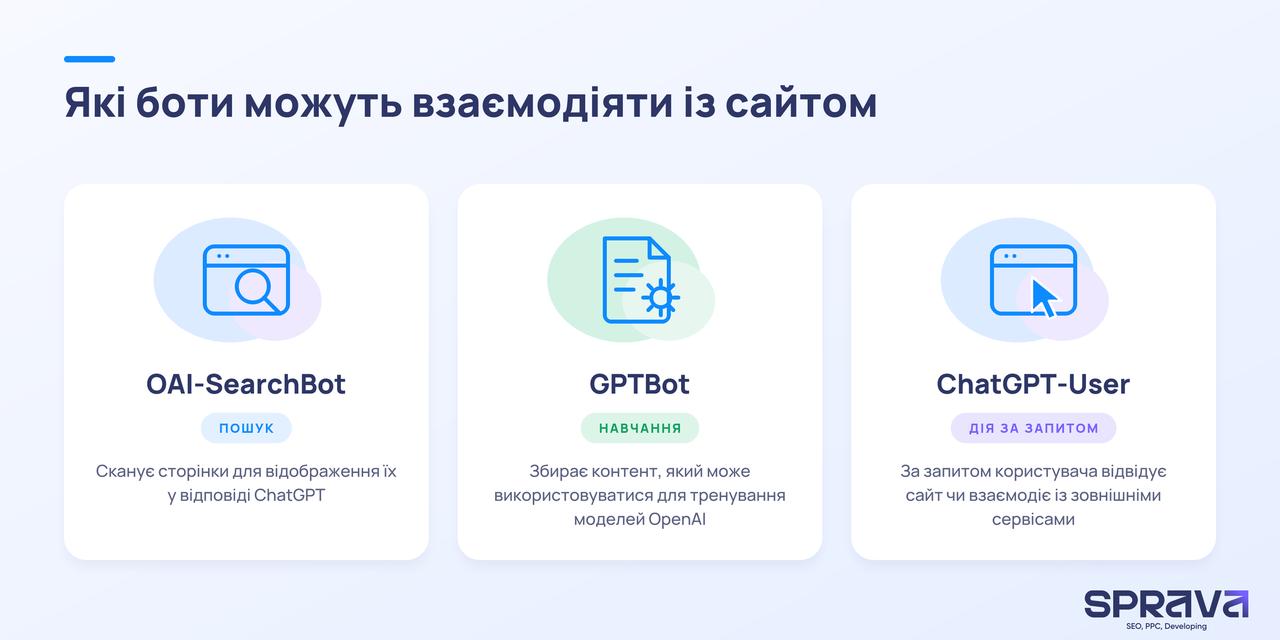
OpenAI does not disclose the exact algorithm ChatGPT Search uses to select sources. So no one can guarantee that a website will be cited in AI answers. To perform search functions, OpenAI uses several bots, each with its own purpose.
| Bot | Area | What it does |
| OAI-SearchBot | Search | Crawls pages to display them in ChatGPT answers |
| GPTBot | Training | Collects content that may be used to train OpenAI models |
| ChatGPT-User | On-demand action | Visits a website or interacts with external services at a user's request |
We've covered the key concepts of AI search. Now let's look at how to promote a website in ChatGPT and which areas deserve special attention, based on Sprava Agency's experience.
For your website to appear in ChatGPT Search results, you need to allow OAI-SearchBot to crawl your pages, that is, to automatically scan their content. This is set up in the robots.txt file.
Since classic SEO and GEO share the same technical foundation, your website should load fast, and key pages should remain accessible to search bots and be properly indexed. For JavaScript websites, set up server-side rendering so that the main page content is available in HTML right away.
Microsoft Bing powers Copilot search and is a major source of web results for ChatGPT Search. To increase your website's chances of appearing in AI answers, make sure it is indexed in Bing.
In Bing Webmaster Tools, the counterpart of Google Search Console, you can submit your sitemap.xml, check whether the search engine sees your pages and find crawl errors. IndexNow helps notify Bing about new or updated pages.
For ChatGPT Search to match your content with a user's query, the page should be structured and consistent. Put the main point at the start of each section, then explain it with examples or details.
The best-performing content offers something that dozens of other texts don't: first-hand experience, case studies, expert commentary. Back up statistics and research findings with links to primary sources.

T. Zheveha
Head of SEO
at Sprava Agency
Unique content has been an important ranking factor in SEO for years, but in the AI era, its value is even higher. The issue is no longer just that users find generic content uninteresting. LLM systems have enough resources to quickly go through a large number of sources and filter out everything that says the same thing in different words. They try to find and highlight unique experience that others don't have. This is exactly the kind of content that gets cited more often and with higher priority.
Headings should reflect the essence of the sections that follow, so that AI can find the text, identify it as a source of information and offer it to the user. Use lists and tables to present data concisely and consistently. Add an FAQ with short answers to common questions, as long as it doesn't duplicate the main text. If relevance matters for your content, regularly check that it reflects the current state of the industry, update the text and indicate the date of changes.
Schema.org markup is code that tells search bots what type of page it is and what its key elements are. For example, Article marks an article, Organization marks company information, and Product marks a product.
Structured data does not guarantee that an AI assistant will cite your page. However, correct markup gives AI systems clearer signals about the page context, making it easier for them to extract the right data.
The E-E-A-T principle (Experience, Expertise, Authoritativeness and Trustworthiness) originated at Google, but its logic also applies to texts that AI systems may use. That's why expert content should be grounded in practice and be genuinely useful to the audience.
To demonstrate expertise, include the author's name, position, experience and specialization in your content. On your "About Us" page, tell readers about your team and areas of work, and in case studies, describe real challenges and the results you achieved.
External mentions provide independent confirmation that a company is real, experienced and active in its field. That's why publications in industry media and authoritative resources, forum discussions, listings in industry directories, reviews on Google Business Profile and Clutch, and PR materials all increase your website's chances of appearing in AI answers.
T. Zheveha
Head of SEO
at Sprava Agency
Brand building has long been part of a company's online marketing strategy. For SEO, it is primarily a way to depend less on Google updates and to build a loyal, steady audience. In GEO, a strong brand with high-quality representation and well-established presence across different areas of activity is the key to getting into the top 3, 5 or 7 citations right here and now for prompts with commercial intent. In Google search, we could see a website in the top 10, 20, 30 and beyond, but AI answers leave much less room to work with. An answer to a user's question usually shows 3, 5, 7 or at most 10 companies, so competition is tougher. To get into these results, you need to do even more work and improve even more factors.
The basic principles of GEO apply to any website, but priorities depend on what exactly the business offers. For e-commerce, it's important to keep product feeds up to date: update prices, check availability and specifications, and provide complete, detailed information on delivery methods and costs, as well as delivery and service areas. Product pages themselves should include a full description, high-quality photos and genuine customer reviews.
For local businesses, Google Business Profile is one of the key sources of information. So update your profile regularly, respond to reviews and make sure your NAP data (company name, address and phone number) is consistent across your website, Google Maps and directories.
The AI assistant can be used to find article ideas, cluster queries, and draft meta tags, schema markup and FAQs.
At the same time, ChatGPT can make up facts, and unedited generated text often looks generic and gives readers no new value. So use AI to create a base, and have an editor and a subject-matter expert verify the data, add first-hand experience and approve the final version.
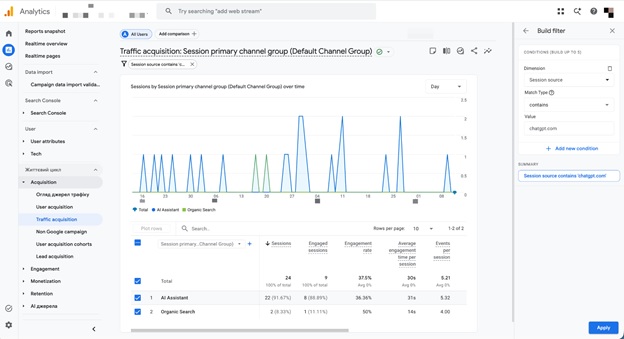
To analyze visits from ChatGPT, open the "Traffic acquisition" report in GA4 and find the AI Assistant channel, which shows traffic from various AI assistants. To view ChatGPT only, filter the data by the chatgpt.com source or the UTM tag utm_source=chatgpt.com.
You can track your website's visibility in AI answers manually by regularly testing prompts, or with specialized tools such as Semrush AI Visibility Toolkit or Ahrefs Brand Radar. Keep in mind that brand citations and mentions do not guarantee rankings, steady traffic or conversions.
T. Zheveha
Head of SEO
at Sprava Agency
It's important to understand that no tool can provide high-quality, complete analytics, because none of them has access to the internal statistics of each LLM. So as of November 2026, it is impossible to fully track all user queries and AI system responses. What's more, the nature of AI search is that every new prompt differs from the previous one, so statistics cannot capture a complete list of search queries. Brand citations for the most typical informational keywords don't bring a business significant profit, because LLM systems aim to keep users within the chat rather than redirect them to a company's page. That's why these tools are only a way to understand where a specific brand stands in terms of its AI presence, while growth in brand visibility by tool metrics is not directly proportional to actual sales from the website.
In addition to third-party SEO tools, you can use official tools from Google and Microsoft to assess your website's visibility in AI search.
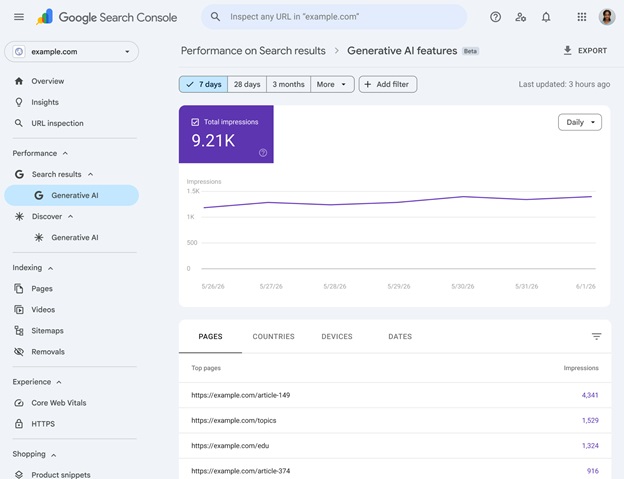
Google Search Console provides access to the Generative AI performance report. It shows how often your website's pages get impressions in Google Search generative features, including AI Overviews and AI Mode.
In the report, you can view:
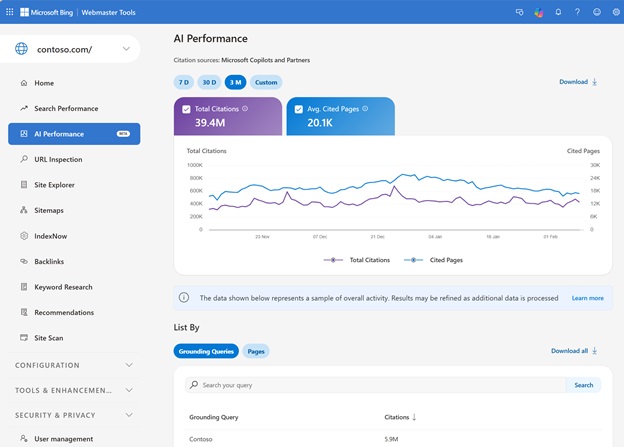
Bing Webmaster Tools from Microsoft provides the AI Performance report with data on page citations in Microsoft Copilot AI answers and Bing AI features.
The report includes the following metrics:
If you're exploring how to get into ChatGPT Search, it's worth knowing not only the optimization methods, but also the mistakes that can keep your website out of AI answers.
Getting into ChatGPT answers depends on the query, content relevance and other factors. That's why no one can guarantee a specific result, let alone a timeframe for achieving it.
We care about improving your sales :)